
Wondering what egg freezing is all about? You’re in the right place! We’ve broken down everything involved into the ultimate guide for what to expect when doing egg freezing.
Egg freezing is the process of stimulating your ovaries to grow more eggs than a usual month to full size, retrieving them from your abdomen, and freezing them so they can be used to try for pregnancy in future.
Two important things to remember:
- Egg freezing doesn’t take any more eggs away from your ovaries than you would usually lose every month anyway (we’ll explain how later!)
- Freezing eggs isn’t a guarantee that they will definitely lead to a pregnancy in future. It just preserves the quality of those eggs at the age you freeze them, which usually gives you a better chance of success than trying with your older eggs in future, especially after age 40.
Egg freezing can be done for many reasons. It can be a necessity for some people due to illness or medical treatment. For others it can be elective egg freezing to preserve future fertility potential and allow them more options for family planning on their own timeline.

Choosing to freeze your eggs is a process that involves several stages.
These include:
- Initial Investigations and Planning
- The Stimulation Cycle
- Retrieval, Freezing and Storage
Initial Investigations and Planning
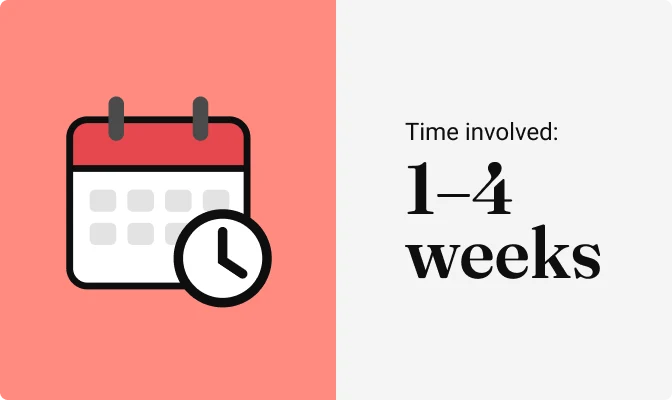
Time involved: 1-4 weeks, depending where you are in your period cycle when you begin.
After deciding you’d like to freeze eggs, the first step is to gather information about your health and fertility that will inform the treatment plan your doctor will recommend for you. Find out more about what this involves <link>
If you take out a 5 or 10 year Egg Freeze Plan, you’ll also get a fertility MOT included when you take out the plan. This very initial assessment can give you valuable information to plan ahead for your goals and make sure the 5 or 10 year plan is right for you.
You’ll likely repeat these initial tests when you complete your plan and start your treatment, so your doctor has the most up to date information on your fertility to plan your cycle.
Stimulation Cycle
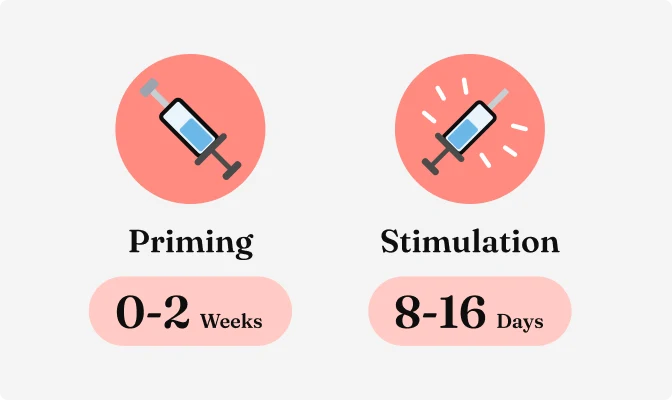
Time involved:
Priming – 0 – 2 weeks (depending on your protocol)
Stimulation – 8-16 days (depending how quickly your ovaries respond)
When you have your plan and medications ready, it’s time to begin your cycle! You can choose a convenient time that suits you and fits around other responsibilities. Keep in mind you will need to align the timing with your period.
For many protocols your cycle begins on the first day of your period. Others may involve priming before your cycle, after ovulation on your previous period. Find out more about what happens during a Stim Cycle <link>
Retrieval, Freezing and Storage
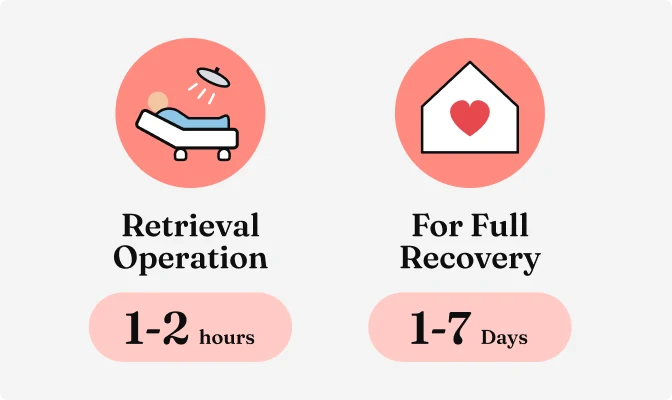
Time involved:
1-2 hours for retrieval operation
1-7 days for full recovery
After all that hard work growing a lot more eggs than usual to full size, it’s time to collect what you’ve grown during your cycle! Find out what happens during egg collection and where your eggs go after they’re collected <link>
Remember, collecting all the eggs from a cycle will not deplete your overall egg reserve. These are eggs that would have disappeared on this cycle regardless. The only difference is with egg freezing your clinic can stimulate all of the potential eggs that month to grow to full size, whereas in a normal month only one would grow to full size and ovulate, while the others would die off. Stimulation and egg retrieval allows your clinic to collect all the potential eggs available rather than letting some die off.
What next?
All eggs that are able to be frozen will be preserved in liquid nitrogen. This flash freezing technique is the latest technology and gives a high chance of survival if you thaw them in future, on par with the survival rate of thawing embryos at most clinics.
Your clinic will only freeze mature eggs that are of sufficient quality to have a good chance of success if used. Find out more about how embryologists decide which eggs can be frozen <link>
You can store eggs for up to 55 years in the UK, so they’ll be ready for you when you want to use them. Currently consent for storage needs to be renewed every 10 years.
The quality of your eggs remains at the age at which they were frozen no matter when you return to use them.
When you’re ready to use the eggs you can thaw them all at once or in smaller batches. You’ll use ICSI <link to what is ICSI> to fertilise the eggs and any embryos that develop from them can be implanted in the same process as the second part of an IVF cycle, or frozen for future use. Read more about using your frozen eggs <Link>
Remember that freezing eggs doesn’t guarantee you’ll be successful when you use them. It does, however, lock in your fertility and egg quality at the age at which you freeze them. This is almost always vastly superior to what it will be at any later age.
The number of eggs you should aim to freeze for a good chance of success varies depending on factors such as your age at the time of freezing, health conditions that could affect egg quality, and how many children you’d like to have.
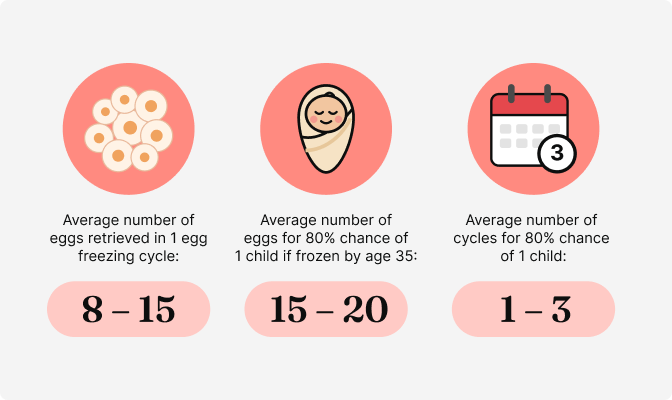
The average number of eggs retrieved in one cycle is 8-15. Some people retrieve more than this and others less.
Generally if you are younger with a higher reserve you’ll retrieve more and vice versa, but no one knows exactly how you’ll respond to stimulation until you do a cycle. What happens for someone else at your age with your AMH and AFC may not be the same for you, as our bodies are all different.
Many people require more than one cycle of egg freezing to reach their ideal number of frozen eggs. In consultation with a doctor you can discuss how many eggs they estimate you could retrieve in one cycle and based on this how many cycles they recommend for you.
The Cost of Egg Freezing
If you’re wondering how much this process costs take a look at our breakdown of the cost of egg freezing in the UK <link>
Don’t have that kind of money in your back pocket? Rather than waiting until you need the money and having to take out credit cards to cover it, plan ahead with us.
We’ve got you covered with 5 or 10 year prepaid saving plans to prepare for these costs, so that when the time arrives you can focus on your treatment without the stress. Find your plan here <link>